I’m in my fifties. My relationship with my skin, my scent, my routines — all of it has changed, and keeps changing.
Menopause does things to your skin that nobody really prepared me for. Cataract surgery made me rethink my entire cleansing routine. And the beauty industry, which has historically talked almost exclusively to women in their twenties and thirties, is only slowly catching up with what women over 50 actually need.
So I write about that honestly. What works for skin that’s changing. What the beauty industry gets right and wrong about ageing. The Asian skincare philosophy I grew up with, handed down from my mother — and now, because Asian beauty is everywhere, my daughters can experience it too. We share our discoveries, and that is a joy of new shared experience I didn’t expect.
The fragrances that smell different at 55 than they did at 25 — and why that’s not a problem, it’s a blessing. Scents I’ve loved transport me to a particular time. New scents mark a new era.
This is not a site about fighting age. It’s a site about navigating it with as much knowledge, pleasure and good scent as possible.
What you’ll find here
Fragrance — reviews, recommendations, gift guides, and the occasional meditation on why a particular scent matters.
Skincare for women over 50 — honest reviews, ingredient deep-dives, and the things I’ve actually learned from my own skin’s changing needs — including the products I discovered during cataract surgery recovery that I now use every day.
Asian beauty wisdom — I’m Taiwanese-British, and I grew up with handed-down wisdom from my mother. I’ve spent years seeking out Japanese skincare, researching the premium brands she preferred, and exploring Asian beauty philosophy before finally embracing it fully. It was worth the wait.
Longevity and wellbeing — my mother and father have both passed on, and losing them made me realise how much I had taken my health for granted.
That loss gave me a quiet determination to live as fully as I can — with mindfulness of body, mind and spirit. Not in a relentless self-optimisation way. In a “this is what’s actually making me feel better at this age” way.
Life at home — food, the garden, the cats, the things that make ordinary days feel considered and good.
A note on why I write
I write because I couldn’t find what I was looking for.
When I was recovering from cataract surgery, I searched for beauty advice written by someone who’d actually been through it. I found almost nothing. When I was navigating menopausal skin changes, I wanted someone who understood both the science and the pleasure of skincare — not just a list of products. When I wanted to understand Asian beauty philosophy from the inside rather than as a trend, I had to piece it together myself.
So I write it. For myself, and for anyone else who’s looking for the same thing and can’t quite find it.
If that’s you — welcome. Pull up a chair. There’s a lot to talk about.
Find me here too
📌 Pinterest: pinterest.com/thescentedabode 📸 Instagram: @thescentedabode ✉️ Get in touch: hello@ravenintegrated.com 🌐 ravenintegrated.com — where I write about marketing and AI
My mother used to make her own skincare from rice. not quite understanding why, just that her skin looked fresh, clean. Decades later, I’ve found three serums that finally explain it.
There’s a skincare memory I keep coming back to.
My mother using rice — actual rice, from the kitchen — as part of her beauty routine. She would wash her face with the rice water collected every evening before cooking our meals. I was a child and I didn’t understand it then. I just noticed that her skin had a quality I couldn’t name. A luminosity. A calmness.
I’ve been thinking about that memory a lot recently, because I’ve been using the Beauty of Joseon serum range for the past few months and there’s something in them that feels like a homecoming. An acknowledgment that the ingredient my mother trusted in her kitchen was not a home remedy but a centuries- old truth that Korean skincare has been quietly building on all along.
Science is now confirming what my mother knew
For generations across East and Southeast Asia, rice water has been used as a skin tonic. Women rinsed their faces with it, soaked cotton pads in it, used it as the basis for homemade skincare. The wisdom was handed down rather than written down.
What we know now — what the formulations in Beauty of Joseon make visible — is that rice bran water is rich in amino acids, minerals and antioxidants that hydrate, soothe and brighten skin. The Glow Deep Serum, which I’ll come to shortly, is 68% rice bran water. Not a trace ingredient. The foundation of the entire formula.
Why I started looking at Korean skincare
Twenty-five years ago, the skincare I admired — the essences and serums associated with the luminous, hydrated skin I wanted — came from Japanese luxury brands. Kanebo was the benchmark. The formulations were extraordinary. The price point, for someone with a young family and a kitchen table business, was not accessible.
So I improvised with what I had. Traditional approaches. Home remedies. Instinctively, SPF on my face to avoid freckles in the sun, which I’m grateful for now.
Korean skincare has changed everything about this. In the last few years it has arrived properly on the UK market — not just in specialist shops but on high streets, in pharmacies, on mainstream beauty sites — bringing with it sophisticated, well-researched formulations at prices that feel almost suspiciously reasonable given what they contain.
Beauty of Joseon is where I landed. And I want to tell you honestly what I’ve found.
The three serums I rotate — and why I rotate them
I don’t use all three every day. I rotate them depending on what my skin seems to need, which changes with the weather, with how much sleep I’ve had, with how demanding the week has been. The rotation is the point — each serum does something slightly different, and together they cover most of what my skin in its fifties actually requires.
Glow Serum — Propolis + Niacinamide
This is the one I reach for now in the mornings.
Propolis — the resinous substance bees use to seal their hives — has been used in Korean skincare for its antimicrobial and healing properties. Combined with niacinamide, which works to even skin tone and refine texture, this serum has become my daily baseline.
What I notice: it gives my skin a healthy, settled quality before I apply anything else. Not a glow in the obvious sense — more a sense that my skin looks like it got enough sleep, even when I didn’t. It’s lightweight, it absorbs quickly, and it doesn’t pill under SPF or makeup.
I’m using this now in the mornings and it’s worth noting that niacinamide is stable in light — so morning use is perfectly fine for this one. You can order it the Glow Serum
Glow Deep Serum — Rice + Alpha Arbutin
This is the one that connects most directly to my mother’s rice water rituals — and the one that has surprised me most.
It’s formulated with 68% rice bran water and 2% alpha-arbutin, targeting pigmentation and uneven skin tone. Alpha arbutin works by inhibiting melanin production — which is what causes dark spots and uneven tone to develop and deepen.
I had been using The Ordinary’s version of the serum and it was great, but I was curious about the Korean version of the ingredient, coupled with rice water.
I want to be honest: I haven’t taken before and after photos. What I can tell you is that there was a sunspot on my nose that I’d had for years and had accepted, having tried various age spot serums including expensive ones from premium beauty brands.
Now, it seems to have faded significantly. I still have some stubborn ones on my forehead and a couple of age spots on the top of my cheeks that I’m working on — but the overall tone of my skin looks more even than it did six months ago.
Alpha arbutin and rice extracts are genuinely quite gentle, making this serum safe for sensitive skin types. This matters to me because some brightening ingredients — vitamin C at high percentages, for example — can be irritating on skin that’s already dealing with the sensitivity that comes with hormonal change.
I should confess something here.
I had been using this serum in the mornings — happily, without question — for several months. It was only when I sat down to write this post and started researching the ingredients properly that I discovered alpha arbutin is best used in the evening, as it can be vulnerable to light and heat. (I don’t think this was mentioned in The Ordinary’s version so I assumed it would be ok with this one.
The reason I hadn’t noticed? The instructions on the packaging are in a font size that, post-cataract surgery, I simply cannot read without my reading glasses. Before my operation, being short-sighted meant I could read tiny text with no difficulty at all — I was practically built for small print. Now I can see across a room perfectly, but the guidance on a skincare bottle requires a separate expedition to locate my glasses for very small print – under 8pt to be precise.
The reading glasses are now living in my skincare drawer, since most product information seems to be in a font that’s too small to read without glasses now.
There’s something rather ironic about this — and perhaps something beauty brands should think about. Women over fifty are your fastest-growing skincare audience. We are also, many of us, navigating vision changes that make the small print on packaging genuinely inaccessible. Larger text on labels would not go amiss.
In any case: if you’re starting with the Glow Deep Serum, go straight to evenings. My research did the work so yours doesn’t have to.
If you’d like to read the full story of my cataract surgery and what it taught me about skincare — including the waterless cleansing routine I now use every day — that post is here
The texture of this serum, I should add, is silky in a way that feels genuinely different from most serums I’ve tried. It sinks in without leaving any tackiness. My skin feels soft rather than tacky— which is exactly the right sensation for skin that’s been working hard all day.
Calming Serum — Green Tea + Panthenol
This is my rescue serum.
I live in Britain. My skin knows it. The combination of central heating, cold wind, and the particular damp grey quality of an English winter does something to mature skin. For many years, I seemed to have skin that would bounce back from harsh cleansing or topical scrubs, in fact I loved the clean feeling it gave me, but now . Redness. Tightness. A general sense of protest.
The Calming Serum is what I reach for when that happens. Green tea is a well-established anti-inflammatory in skincare — it calms redness and protects against environmental stress. Panthenol (provitamin B5) supports the skin barrier and helps it hold onto moisture.
Together they work quickly. Not dramatically — this isn’t the serum version of a cold compress — but within the time it takes to finish getting ready, the redness has settled and my skin feels like itself again.
These are not aggressive serums. They’re not going to produce dramatic results in a week. If you’re looking for the kind of transformation that changes your face in a fortnight, these aren’t that. What they do is work steadily, gently, and consistently — which is, I’ve come to believe, exactly how skin in its fifties wants to be treated.
Not pushed. Nourished.
A note on price and where to find them
This is where Korean skincare genuinely changes the conversation. These serums are available in the UK through Lookfantastic, Cult Beauty and Amazon, typically in the £10–£18 range each. For the quality of formulation — the ingredient percentages, the research behind them, the results I’ve experienced — that feels almost unreasonably good value.
The full circle
I started this post thinking about my mother and her rice water rituals. I’m ending it thinking about my daughters — one of whom has already borrowed my Calming Serum and declared it “actually good, Mum, genuinely.”
There’s something in that continuity that I find quietly moving. The wisdom my mother handed down without explaining it, now available in beautifully packaged bottles on a UK high street, now being passed on to the next generation who will discover their own relationship with these ingredients.
Rice water. Centuries of it. Finally in a serum I can afford and my daughter will steal.
Have you tried Beauty of Joseon — or any Korean skincare that’s become a non-negotiable for you? And do you have memories of traditional skincare ingredients from your own family? I’d love to hear in the comments below.
And if any of the vision or packaging observations resonated — or if you’ve had your own post-surgery skincare discoveries — tell me that too. These are exactly the conversations I started this blog to have.
It’s been snowing this weekend, in the middle of March! when it’s supposed to be spring. The unpredictable weather has caused all sorts of problems in my garden, the daffodils which were just starting to bloom have all died, and the cherry blossoms are looking all very sorry for the snowy blizzard conditions. Not that I’m complaining too much, the house is warm, and we are enjoying the snowday in watching films on Netflix.
The weather and central heating have made my skin blotchy with dryness. Whenever this occurs, I use a facial oil to boost the level of moisture in my skin. If you’d like to make your own facial oil, there’s an easy recipe here
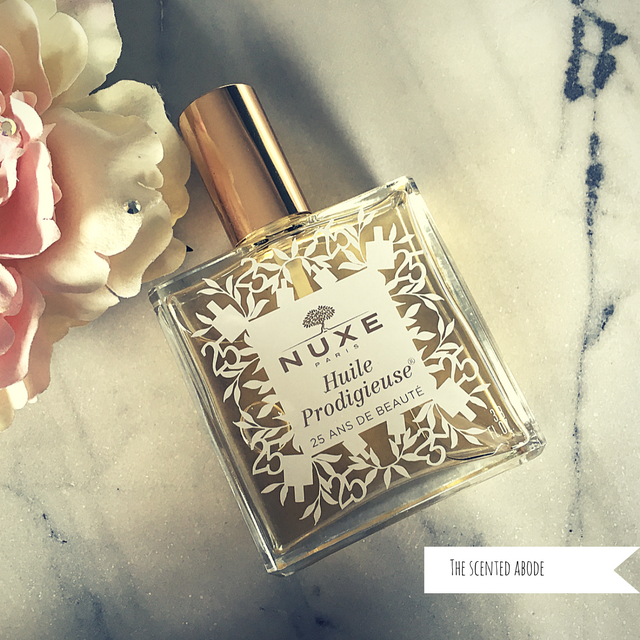
It boasted many uses, from adding shine and moisture to your hair, reducing stretch marks, alleviating dry flaking skin, reducing the appearance of fine lines and wrinkles, it truly is an amazing multi-purpose oil.
With so many uses, it means that it has reduced the number of products in my bathroom cabinet.
I use it as a light body moisturiser, a quick spritz after a shower means it locks in skin softness and prevents dry, cracked skin. It is so quick; I don’t have to wait for the oil to sink in before getting dressed because it’s a dry oil.
On my hair, I spritz it into my hairbrush after blowdrying so that it protects and adds shine to my hair and seems to make my hair between washes last longer.
On my face, I can use it by mixing it into my moisturiser and add extra oomph to combat the recent cold weather.
The ingredients in the oil all have skin benefits. There are no less than seven botanical oils, sweet almond, camellia, hazelnut, borage, macadamia and argan oils and is free of preservatives, silicone or mineral oils.
The scent of the oil is a warming fragrance like a comfort blanket, or a warm hug and reminds me of vanilla and sandalwood. It is described by the brand as orange blossom, magnolia and sweet vanilla.
Hmm, even though I love making a facial oil because this has so many uses, I think this is going to be a permanent addition to my skin care routine.
Sunshine and spring weather has finally emerged and is making me feel it’s time to give my skin a spring clean.
I love the scent of Grapefruit and on a recent trip to the high-street, I purchased this lovely tube of refreshing Grapefruit skin sorbet from The Body Shop. The scent is uplifting and energising. Since my budget did not stretch to getting any further skin treats, I decided to make my own refreshing bath soak and skin scrub in one.
This is the simplest way to get the scent of grapefruit to fill your bathroom and give skin a refreshing spring clean.
All you need is half a grapefruit. Just squeeze the juice into a bowl and mix in a large helping of rolled oats (I had porridge oats in my store cupboard), next add in a teaspoon of Green Tea leaves, since I’d received a gorgeous tin of White Peony Tea, I used this to ensure the antioxidant benefits found in Tea would make its way onto my skin.
To add moisture, I added half a teaspoon of Jojoba oil to the mix.
To boost the scent of the grapefruit, I added Bergamot essential oil. You can add any citrus-scented essential oil that you have to hand if you don’t have grapefruit.
Add the zest of the grapefruit skin by grating it with a fine grater.
By now this mix looks clumpy and can the smell of Grapefruit and the citrusy scent has already filled my kitchen with its wonderful aroma.
You can now use it as a skin scrub or use it as a bath soak.
So that the small bits of the porridge do not float around the bath, I filled some empty tea bags. You can order these empty tea bags online or use a tea infuser.
These tea bags with fresh ingredients will keep in the fridge for a couple of days.
Just hang the tea bag under a hot running tap in the bath and the aroma of Grapefruit and all the lovely ingredients that have been used in this mix will infuse the bath water with its scent and goodness.
There’s just nothing like a good soak, except perhaps smoothing over the Grapefruit souffle body lotion to complete the experience.
If you like citrus scents read my latest post about how it helped me through myopia and menopause related Cataracts : Lemon Verbena
This is a quick and simple recipe for making your own gentle eye make-up remover.
Why Choose a Homemade Eye Makeup Remover?
In a world of complex ingredient lists, returning to basics is often the kindest thing we can do for our skin. Many commercial removers contain harsh alcohols or synthetic fragrances that can strip the delicate eye area. By creating your own gentle solution, you control exactly what touches your skin—ensuring it remains hydrated and calm.
The 2-Ingredient Recipe (Rosewater & Oil)
The beauty of this tonic lies in its simplicity. I have found that a 50/50 split of pure rosewater and a light carrier oil (like almond or jojoba) creates a dual-phase remover that rivals any luxury brand. The rosewater soothes inflammation, while the oil effortlessly dissolves even stubborn pigments without the need for rubbing.”
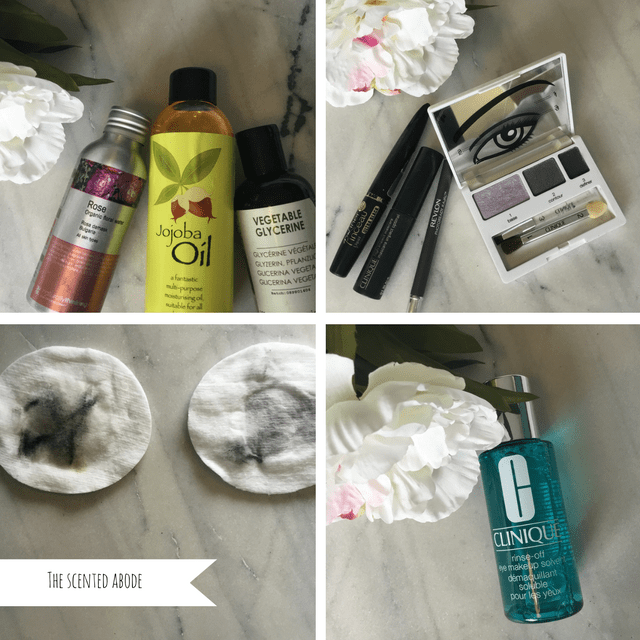
All you need is some good quality oil, Rosewater and Glycerin.
Make it in small batches as the ingredients are all natural and there is no preservative so it is best to make it fresh every few days, 50ml should last between 3-4 days if you plan on using it every morning and night.
Pour the Rosewater, Jojoba Oil and the Glyercin in a small bottle. Shake vigorously to combine the ingredients. This recipe is very similar to the home made Micella Water recipe which I wrote about a while ago. You can see the post by clicking this link.
As you can see from the test below, I applied a very dark colour pallet of eye shadow, eye liner and mascara and used the home made version on one eye lid and compared this to the Clinique Eye Make-up remover that I occassionnally use.
I was surprised as the Clinqiue remover was good, I’ve always used this as it’s non-scented and wipes away Make-up with only a couple of swipes. But the home-made version took off much more make-up with just one swipe. Result!
Better still is that it cost considerably less and smells lovely because of the Rosewater.
I’ve been using Rosewater for many years now and I don’t think there is anything better than this gorgeous smelling scented liquid.
simple ingredients for eye make-up remover
It has been nearly a decade since I first shared this recipe, and its relevance has only grown for me. Following my recent cataract surgery, I had to be incredibly mindful of what I used around my eyes. After the initial recovery period where makeup was off-limits, returning to this gentle, 2-ingredient remover was a sensory joy—it provided the cleanliness I needed without any of the irritation of synthetic brands. While I have continued to experiment with high-end products since then (which I’ll be sharing soon in a dedicated post on eye care for mature skin), this homemade classic remains my trusted baseline for sensitive days.
This is the easiest recipe to make at home which will revive and refresh tired aching feet. I had all the ingredients in my garden. Better still, the only cost involved was just the use of the pre-made little tea bag pouches which I got online. One hundred of these little pouches ready to fill with tea leaves, herbs or anything which you want to infuse or soak in hot water.
For this refreshing herb tea foot soak, I simply picked a small bunch of mint leaves, a few sprigs of rosemary and some lavender buds which were still flowering in the last days of summer.
A dash of Dead Sea salt, which I already had in my cupboard and a few drops of Peppermint and Lemon Essential Oils, and Orange Blossom Water all mixed roughly together in the tea bag pouch.
Soak in a bowl of boiling water for as long as you want and pour into a warm bowl of clean water. Ready to soak tired weary feet.
I know this seems like quite a bit of effort, but after a long day at work, I like the idea and ritual of preparing something a little indulgent, a little bit of me time to indulge in. The scent is uplifting and has this magical way of transforming the room into a scented retreat.
Feet are now soaked and feeling light and refreshed. Hmm now for that pedicure, a colourful treat for my toes.
Dead Sea Bath Soak ingredient for DIY Foot Soak
Peppermint, Lemon and Carshalton Lavender Essential Oil
Easy to make Rosemary, mint and lavender foot soak
Yesterday I finally got around to planting the two rose bushes purchased a couple of weeks ago. I hadn’t got round to putting them into the garden as the previous weekends had been busy and the weather had been, well pretty unfriendly.
So when I looked out of the window in the morning, there was no more excuses. I dug the soil, as it had been wet, the ground was soft and much easier to dig. With some bonemeal to sprinkle into the earth around the rose bush, I patterned down the earth around the two rose bushes.
I can hardly wait for the first rose buds to appear. The rose bushes cost just the same as a bunch of ready cut roses from the Supermarket, but hopefully, they will yield a lot more blooms throughout early summer and Autumn. I chose fragrant varieties in deep pink and white.
Rosewater Facial Cleanser
Meantime, in the bathroom, I’d run out of face wash. I prefer to wash the day’s make-up off with soapy cleanser, somehow the foaminess feels so much more refreshing than just the Rosewater toner/cleanser that I use afterwards.
Since I have a bottle of Doctor Bonner’s Castille Soap (baby wash version) waiting to find a use in my cabinet, I’m using this for the first time to make a batch of facial cleanser. As it is supposed to be non-scented, it will make a good base for a natural facial wash, though it still has the scent of Castille soap.
I’ve combined this with Rosewater along with Jojoba Oil and the scent of rose along with Jasmine makes the facial wash a floral sensation.
Here’s the ingredients:
1/4 cup Doctor Bonner’s baby non-scented Castille Soap (you can use solid or liquid)
1/4 cup Rosewater
1 teaspoon Jojoba oil, 1/2 teaspoon Rosehip Oil*
4-8 drops of your chosen blend of essential oil (I’ve chosen to use a 10% dilution of Jasmine Absolute and Rose Geranium)
Making the facial wash could not be easier, just combine all the ingredients in a bottle shake vigorously to combine and put a cap on.
I use this at night to remove make-up and afterwards use the Rosewater and Witch Hazel Toner. Just wash face until all trace of make-up has gone. It is quite watery, though if you use a muslin, simply squirt a bit on a damp muslin and rinse until clear.
That’s it, and best of all it’s all natural and can be customised to suit your skin
*I have chose Jojoba Oil and Rosehip oil as these have great anti-aging properties. You can use Coconut or Sweet Almond or any other natural oil best suited to your skin instead. Experiment until you get the right consistency you prefer
This is one of my favourites as there’s only one way to describe the scent in this bottle and that is its sublimely indulgent.
The heady scent of Jasmine will hit you the moment this makes contact with water and skin.
The scent is as natural and as authentic as you can get to real Jasmine. I love the idea of enveloping myself in its aroma, drinking in the scent as if I’m sipping my favourite Jasmine Tea from Whittards.
From outside in, the scent of Jasmine can be a natural drug to lift your mood. It stimulates the release of serotonin which boosts energy. Perhaps this is the reason I love it so much.
As it is one of the most expensive essential oils to buy, I have a small bottle which contains a 10% dilution in jojoba oil, which I keep to add a few drops into the night time facial oil I made.
Around 8 million Jasmine blooms are needed to produce a kilo of essential oil, commercially the blooms are hand picked at night when their scent is at their most powerful. I love the idea that the magic of the scent is only released at night. There’s something very Arabian nights about this. It also means it’s one of the most expensive oils to buy.
It also reminds me of my early childhood home where we had a Jasmine bush climbing outside our front door.
In in early evening as the blooms released their scent, our home was bathed in the delicate scent. I can’t explain how I remember this, I just do and that’s mostly the reason why I am always drawn to anything that’s Jasmine scented.
It started to snow today, little fluffy flakes which made the air feel very cold. While I love snow, my face, particularly my eyes don’t.
This homemade Anti-aging eye serum is more like a gel than a serum. That’s because it’s full of the goodness of Rosehip oil.
Rosehip Oil is packed full of antioxidants, is super moisturising and is considered a “dry oil” meaning that it’s quickly absorbed by the skin. It heals scars, is great for pigmented skin and is a great all-round moisturiser for your skin.
Combine this with the calming benefits of Chamomile and the delicate scent of Jasmine, with the antioxidants from Green Tea to prevent dark circles, this nightly eye serum has kept my delicate under eye area nourished, and in spite of the cold weather, the area under my eyes feel soft and replenished.
To make this eye gel is very simple.
In a pan, put a jug in simmering hot water.
(makes 30ml)
Add your ingredients:
3 ml of Bees Wax
20ml of Rosehip Oil
7ml of Shea Butter
Wait until melted.
Now add some Green Tea (I’ve used a Green Tea bag and simply sprinkled this into the mixture to infuse the green tea into the oil.
Add one drop of Chamomile and Jasmine to the mixture
Leave to simmer for 5 minutes and then strain the mixture through a fine sieve into a small container or jar.
Leave to cool.
The beeswax should emulsify and hold the Rosehip and Shea butter together in a gel-like consistency.
I tend to use this at night just before bed so that all the goodness of the rich serum works overnight. Just tap a very small amount onto the skin under your eye, being careful not to get any into your eyes.
Every year, I look for gifts to give friends and family that are unique, thoughtful and show that their tastes or what they like have been considered and reflected in the gift.
On most occasions, their gifts to me have out done me in every respect, so this year to show my appreciation, the gifts I’ve made are uniquely personalised. Even better, I’ve not spent any time walking around shops trying to find something special, because the ingredients are already in the cuboard ready to be made into something special and take very little time or effort to prepare and make.
If you have ever tried the Shea Butter Hand and foot cream from L’Occitane or from Burt’s Bees, these are lovely little gifts to give and receive. The only thing is that there’s a possibility that someone else has had the same idea and purchased the very same. They smell wonderful, with a range of delicate scents and I must admit are lovely gifts to receive.
To make these Foot and hand Salves is very simple, easier than baking a cake in fact. All you need to do is measure out the ingredients, gently melt them in a jug in a pan of simmering water, add the essential oils and once melted, pour into your chosen containers. Personalising the scents makes these gifts unique, especially if you know what scents they enjoy the most.
Ingredients for the footsalve:
1 tablespoons of Argan Oil
2 tablespoons of Coconut Oil
1 tablespoon beeswax
4 tablespoons of unrefined Shea Butter
1/4 tsb of essential oils – a combination of Peppermint and Cedarwood (for the boys) or Peppermint and Lavender (for the girls)
To make the Hand Salve variant, you can change the oil and use Jojoba or Rosehip Oil, whichever you think their hands (or your own) will appreciate the most and add your choice of essential oils to add scent. Beeswax and the Shea Butter will emulsify and give the salve it’s lovely thick creamy texture.
Better still, if you want to make the Handsalve to treat age spots (after all, most beauty mags will tell you it’s your hands that show the first signs of aging) select the essential oils for their skin therapeutic benefits.
That’s it. All there is to it for making scented rich moisturising salves. Perfect as a gift or an indulgent luxurious treat. Hmm I think I’m going to find a bit of me time for a Manicure and try some of the handsalve I made.
Sweet Orange and Lavender Hand Salve, made with Shea Butter and JoJoba Oil
Contains information related to marketing campaigns of the user. These are shared with Google AdWords / Google Ads when the Google Ads and Google Analytics accounts are linked together.
90 days
__utma
ID used to identify users and sessions
2 years after last activity
__utmt
Used to monitor number of Google Analytics server requests
10 minutes
__utmb
Used to distinguish new sessions and visits. This cookie is set when the GA.js javascript library is loaded and there is no existing __utmb cookie. The cookie is updated every time data is sent to the Google Analytics server.
30 minutes after last activity
__utmc
Used only with old Urchin versions of Google Analytics and not with GA.js. Was used to distinguish between new sessions and visits at the end of a session.
End of session (browser)
__utmz
Contains information about the traffic source or campaign that directed user to the website. The cookie is set when the GA.js javascript is loaded and updated when data is sent to the Google Anaytics server
6 months after last activity
__utmv
Contains custom information set by the web developer via the _setCustomVar method in Google Analytics. This cookie is updated every time new data is sent to the Google Analytics server.
2 years after last activity
__utmx
Used to determine whether a user is included in an A / B or Multivariate test.
18 months
_ga
ID used to identify users
2 years
_gali
Used by Google Analytics to determine which links on a page are being clicked
30 seconds
_ga_
ID used to identify users
2 years
_gid
ID used to identify users for 24 hours after last activity
24 hours
_gat
Used to monitor number of Google Analytics server requests when using Google Tag Manager