Washing Hair After Cataract Surgery: The safety swimming goggles hack

Aveda Botanical Repair and swimming goggles
Aveda botanical repair and swimming goggles

Recovering from cataract surgery required a brief pause in my usual haircare routine. While the procedure itself was quick, the post-operative care required some serious thought—especially when it came to everyday tasks like hair washing.

Having worn contact lenses for years, I was already hyper-aware that getting water into your eyes can introduce unwanted bacteria. Because it is absolutely vital to keep water, soap, and pressure completely away from the healing eye during the first week, the prospect of washing my hair felt incredibly daunting.

Today, I want to share my exact personal experience, the clever safety hacks I used to navigate this transition smoothly, and how I turned a medical restriction into a comforting, holistic self-care ritual.

Post-Op care:

Wooden comb through wet hair

My Step-by-Step Post-Op Hair Routine

If you are nervous about getting your face wet, you do not have to rush into a full wash immediately. Here is the exact, protective routine I used to stay fresh while keeping my healing eye completely dry:

Days 1–3: Refresh with Dry Shampoo

For the first few days after the operation, I didn’t wash my hair with water at all. Instead, I opted for a high-quality dry shampoo. This completely removed the risk of accidental splashes during those critical early days while keeping my scalp clean and comfortable.

Day 4 Onwards: The Swimming Goggles & “Backward Tilt” hair wash

When it was finally time for a proper wash, I came up with a plan using a pair of swimming goggles I had originally purchased for a beach holiday last year.

Swimming goggles create an excellent physical seal to protect your eyes from stray drops of water or running soap. For an extra layer of safety, I placed a couple of dry cotton wool pads inside the lens area over my treated eye before putting the goggles on.

Once secured, I stepped into the shower, turned completely around so the shower head faced my back, and aimed the water stream carefully while keeping my head tilted firmly backward. This ensured that the water splashed exclusively over my forehead and down my back, draining safely away from my face.

Haircare Tip: I repeated this exact process a month later when I had my second eye operated on, and it worked perfectly both times.

Elevating the Experience with Plant-Powered Care

Once safely in the shower, I wanted to use products that offered genuine therapeutic and botanical benefits. For a very long time, I have been a fan of Aveda’s Botanical Repair range. Built on ancient Ayurvedic philosophies, this collection focuses on holistic balance and uses plant-powered, bond-building technology to naturally strengthen hair without heavy, stripping chemicals.

The aroma alone transforms the bathroom into a spa. It fills the air with a calming, blend of lavender, rosemary, ylang-ylang, and marjoram.

Why I Trust This Range (Especially Post-Menopause)

This range has been my absolute go-to since navigating menopause, a time when I noticed my hair beginning to lose its original thickness, strength, and lustre.

Engineered around a plant-based, triple-layer repair technology, the formula works systematically to restore compromised hair:

  1. The Cortex: Micro-molecules derived from corn or sugarcane penetrate the inner layer of the hair shaft to build structural bonds from within.
  2. The Cuticle: A nourishing macro-green blend of sacha inchi, green tea seed, and avocado oils mimics the hair’s natural outer layer to smooth the cuticle and detangle strands beautifully without heavy silicones.
  3. The F-Layer: Coconut and corn derivatives replicate the hair’s outermost, water-resistant barrier, locking in a healthy shine and guarding against environmental damage.

I usually shampoo twice. Because the formula is highly concentrated, a very small amount goes an incredibly long way.

My can’t live without product is the Aveda Botanical Repair Leave-In Treatment. It brilliantly acts as a protective conditioner and a styling product all in one. Because it shields hair from heat damage while smoothing frizz perfectly, I find I don’t need to apply any additional styling creams or gels—keeping my haircare routine wonderfully simple.

Because you want to minimize any tangles, tugging, or pulling anywhere near your face right now, I use a wide-tooth wooden comb to gently detangle your hair, always working mindfully from the ends up to the roots.

From my mother’s garden to mine

Lavender harvest
Lavender harvested from the garden

Every time I open these bottles, the herbal aroma instantly reminds me of my childhood home. Growing up, my mother cultivated both rosemary and lavender in our family garden, harvesting them regularly to brew a traditional, homemade hair rinse. She used it on our hair constantly to give it an incredible, healthy shine, but she also knew the functional secrets of those plants: their powerful, natural antibacterial and protective properties.

In Traditional Chinese Medicine (TCM), these two botanical powerhouses represent a beautiful Yin and Yang balance for total scalp health:

  • Rosemary (Mi Die Xiang 米迭香): A warming herb known to stimulate the movement of Qi (energy) and blood circulation. In TCM, hair health is a direct reflection of blood vitality. By stimulating the scalp, rosemary delivers essential nutrients directly to the hair follicles.
  • Lavender (Xun Yi Cao 薰衣草): A cooling, calming herb that clears heat and soothes cutaneous irritation, perfectly balancing the energetic warmth of the rosemary.

Today, I grow both rosemary and lavender in my own garden. At the end of every season, I lovingly harvest the lavender and tie them into fragrant bundles, placing them in vases all around my home. It acts as a completely natural air freshener that feels exceptionally fresh and deeply grounding all at once. In TCM, these ambient botanical scents soothe the Shen(the spirit and mind), making the entire home feel like a peaceful sanctuary during recovery.

A time for patient healing

Recovering from surgery is a gentle reminder that our bodies deserve time, patience, and protection. By pairing the practical safety of swimming goggles with the timeless, plant-powered wisdom passed down by my mother, a simple shower can transcend a medical chore and become a moment of deep healing.

If you are preparing for your own surgery, take it one slow, mindful step at a time. Put on your goggles, tilt your head back, and let nature lend you a helping hand!

Disclaimer: Always follow your specific ophthalmologist’s instructions regarding when you can safely wet your hair and face after surgery, as individual recovery timelines and protocols may vary.

How scent from my garden became an act of self-care

Cut roses from garden by my workspace
Scented roses from the garden

I had a busy work week and last Friday, I found myself heading off to the A&E to have a sebaceous cyst looked at, after the nurse at my GP said they couldn’t help me further after a course of antibiotics the practice had prescribed.

When I finally returned home after the long wait to see one of the consultants, knowing that I had to go back on Saturday, because they couldn’t treat me that day, I turned to my happy place; the roses that I had planted about 3 years ago, now coming beautifully into bloom.

Cutting a few stems and placing them in a vase on my desk made me feel happy, a welcome distraction from hospitals and what that entailed. I cut some rosemary and placed this in a vase so it would sit on my windowsill behind my desk.

The science of the “Happy Place”

We often think of comforting fragrances as a luxury, but modern science proves they are a physiological intervention. There is a profound medical field called Psychoneuroimmunology—the study of how our emotional brain interacts directly with our nervous and immune systems.

When we experience sudden trauma or work related stress, our bodies flood with cortisol (the stress hormone). In clinical studies, high cortisol levels have been shown to delay physical wound healing by up to 50%*. It slows down cellular repair and constricts microcirculation.

Scent can be a shortcut straight to the limbic system—the brain’s ancient emotional control centre. 

So when you inhale an authentic, uplifting botanical fragrance, your brain instantly signals your nervous system to switch off the “fight-or-flight” response. By dropping your cortisol levels, a happy scent physically allows your body to redirect its resources toward cellular recovery and healing. 

My garden brings comfort to my mind, and it is also a way to help repair my body.

I have to admit that I had not tended to the roses and only purchased soil improver to ensure the roses would bloom over the coming months and some rose fertiliser, sprinkled around them and raked in.

From Garden to Bottle: Bringing the Antidote Indoors

They are now entering their most beautiful phase of growth, so each morning before doing anything else, I will take a pair of secateurs and give them a light pruning, taking away spent rose heads so that the plants continue to bloom well into autumn.

While I am fortunate to watch Gertrude Jekyll and The Poet’s Wife bloom right outside my window, you don’t need a mature cut-flower garden to harness this therapeutic power. The beauty industry has long looked to these exact heritage botanical profiles to create scents that do more than just make us smell good—they alter how we feel.

The roses were an investment – I guess looking back little did I know they are also an act of self-care.

If you are looking to bring this grounding, anti-stress ritual into your daily routine, you can explore it through fragrances such as:

  • Affordable budget friendly High-Street Everyday Mist: For a light, accessible burst of morning optimism, The Body Shop’s British Rose offers a clean, dewy, straight-from-the-flowerbed freshness that acts as a perfect midday pick-me-up at your desk.
  • Historic rose scent : To truly replicate the timeless, old-world rose experience, look to L’Occitane’s classic Rose Eau de Toilette. It beautifully captures the elegant, velvet depth of traditional rose species—the very same historic heritage varieties you can source and plant in your own space via David Austin Roses.
  • Luxurious and Aromatic: If you want the a sophisticated pairing of floral and herbal notes with white musk, Jo Malone London’s Rose & White Musk Absolu is the ultimate luxury. By weaving authentic rosewater with sharp, earthy rosemary, it has a crisp scent that helps with mental clarity.

A New Lens: Navigating Cataract Surgery, Menopause, and the Scent of Recovery

L'Occitane Eau de toliette. Now has new packaging
Home » lifestyle
Visit L’Occitane’s site for Vervine Eau de toilette with new packaging

Hello again,

It’s been a while since I last shared a scent story here. Life, as it often does, required a bit of a “pivot.” For the past few months, I’ve been navigating a journey that many women face but few talk about in the world of lifestyle and beauty: experiencing Menopause, High Myopia, and Cataract Surgery.

Clarity and Contrast: Navigating Menopause and Cataract Surgery

The last few years have been hectic, helping my daughters find their way through higher education, balancing that with the ever increasing pace of change at work, but always finding personal enjoyment through scent. But as my estrogen levels shifted, so did my sight. I learned that for those of us with high myopia, the “menopause ” can sometimes bring cataracts forward much earlier than expected.

The Reality of Mid-Life Vision Shifts

I found myself like many people, getting older also meant getting reading glasses or in my case a combination of multi-focal contact lenses and high strength multi-focal glasses. It was manageable, but for the last couple of years, I struggled with both near and far sight and couldn’t focus. It was on my last visit to the opticians where during the consultation, the optician told me that I had had the cataracts for years but they had been very small and were gradually getting worse. It was time to get a referral to the GP to get an appointment with a specialist.

Inevitably, surgery was the recommended path forward. If you’re thinking about it and have been delaying the idea of surgery. Speak to your optician, explore the options available and don’t wait for things to get worse. I can honestly say it’s the best decision I made to have cataract surgery.

I opted to use my work private health care insurance to have a better type of lens implants. In the UK, the NHS will provide basic monofocal lenses. So for a small premium, I elected to get the multifocal version, the type that would be very similar to how my contact lenses helped me see things at an intermediate and distance range.

I’ll cover off the process in a different post for another time.

Sensory wellbeing: My Recovery Essentials

During recovery, when I couldn’t wear my usual makeup or even splash my face with water, there was one sense that I leaned on: Scent. I found myself returning to one of my absolute favorites from L’Occitane. There is something about the Lemon Verbena—and especially the Verbena with Mint—that helped lift my spirit. During the short recovery after the cataract surgery, the sharp, zesty “frosted lemonade” scent was the clarity and it became the sensory anchor that helped lift my spirits.

What’s Next for The Scented Abode? I’m relaunching this space not just to talk about perfume, but to explore how we navigate the “mid-life shift” with grace and some helpful information that I’ve learnt. Over the coming months, I’ll be sharing:

  1. The Waterless Cleanse: How I redesigned my skincare routine when water on my face was off-limits.
  2. The “Strong Lip” Phase: How I felt “assembled” when I couldn’t wear eye makeup.
  3. Sensory Weight Loss: How I used citrus scents to help me lose 20kg naturally.

Recovery isn’t just about healing; it’s about rediscovering the world through a new lens. I’m so glad you’re here to see it (and through the senses of sight and through scent) with me.

If you’re new to this site, welcome. Please explore other content, such as the home made skincare such as the Rosewater toner recipe

Spring clean your skin with Grapefruit 

Sunshine and spring weather has finally emerged and is making me feel it’s time to give my skin a spring clean.

I love the scent of Grapefruit and on a recent trip to the high-street, I purchased this lovely tube of refreshing Grapefruit skin sorbet from The Body Shop. The scent is uplifting and energising. Since my budget did not stretch to getting any further skin treats, I decided to make my own refreshing bath soak and skin scrub in one.

This is the simplest way to get the scent of grapefruit to fill your bathroom and give skin a refreshing spring clean.

All you need is half a grapefruit. Just squeeze the juice into a bowl and mix in a large helping of rolled oats (I had porridge oats in my store cupboard), next add in a teaspoon of Green Tea leaves, since I’d received a gorgeous tin of White Peony Tea, I used this to ensure the antioxidant benefits found in Tea would make its way onto my skin.

To add moisture, I added half a teaspoon of Jojoba oil to the mix.

To boost the scent of the grapefruit, I added Bergamot essential oil. You can add any citrus-scented essential oil that you have to hand if you don’t have grapefruit.

Add the zest of the grapefruit skin by grating it with a fine grater.

By now this mix looks clumpy and can the smell of Grapefruit and the citrusy scent has already filled my kitchen with its wonderful aroma.

You can now use it as a skin scrub or use it as a bath soak.

So that the small bits of the porridge do not float around the bath, I filled some empty tea bags. You can order these empty tea bags online or use a tea infuser.

These tea bags with fresh ingredients will keep in the fridge for a couple of days.

Just hang the tea bag under a hot running tap in the bath and the aroma of Grapefruit and all the lovely ingredients that have been used in this mix will infuse the bath water with its scent and goodness.

There’s just nothing like a good soak, except perhaps smoothing over the Grapefruit souffle body lotion to complete the experience.

If you like citrus scents read my latest post about how it helped me through myopia and menopause related Cataracts : Lemon Verbena

Home Made Gentle Eye Make-up Remover

Update (May 2026): 

DIY Eye Make-up Remover

This is a quick and simple recipe for making your own gentle eye make-up remover.

Why Choose a Homemade Eye Makeup Remover?

In a world of complex ingredient lists, returning to basics is often the kindest thing we can do for our skin. Many commercial removers contain harsh alcohols or synthetic fragrances that can strip the delicate eye area. By creating your own gentle solution, you control exactly what touches your skin—ensuring it remains hydrated and calm.

The 2-Ingredient Recipe (Rosewater & Oil)

The beauty of this tonic lies in its simplicity. I have found that a 50/50 split of pure rosewater and a light carrier oil (like almond or jojoba) creates a dual-phase remover that rivals any luxury brand. The rosewater soothes inflammation, while the oil effortlessly dissolves even stubborn pigments without the need for rubbing.”

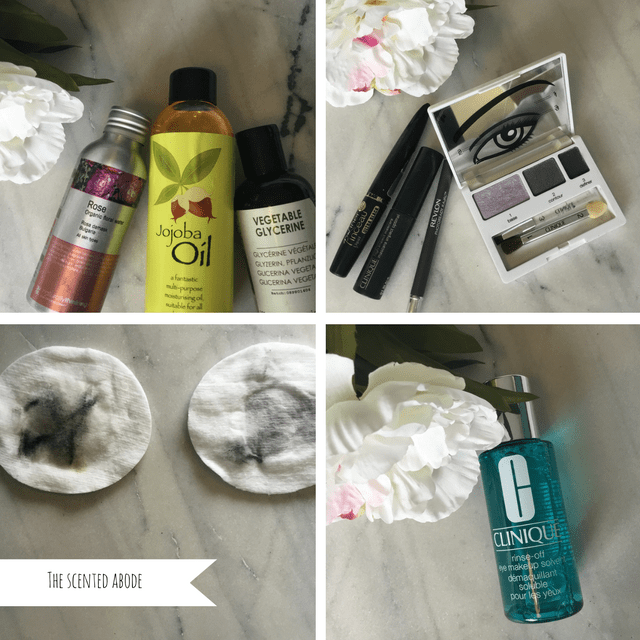
All you need is some good quality oil, Rosewater and Glycerin.

Make it in small batches as the ingredients are all natural and there is no preservative so it is best to make it fresh every few days, 50ml should last between 3-4 days if you plan on using it every morning and night.

Ingredients:

20ml Rosewater

20ml Jojoba oil

10ml Vegetable Glycerin

How to make:

Pour the Rosewater, Jojoba Oil and the Glyercin in a small bottle. Shake vigorously to combine the ingredients. This recipe is very similar to the home made Micella Water recipe which I wrote about a while ago. You can see the post by clicking this link.

As you can see from the test below, I applied a very dark colour pallet of eye shadow, eye liner and mascara and used the home made version on one eye lid and compared this to the Clinique Eye Make-up remover that I occassionnally use.

Home Made Eye Make-up remover test

I was surprised as the Clinqiue remover was good, I’ve always used this as it’s non-scented and wipes away Make-up with only a couple of swipes. But the home-made version took off much more make-up with just one swipe. Result!

Better still is that it cost considerably less and smells lovely because of the Rosewater.

I’ve been using Rosewater for many years now and I don’t think there is anything better than this gorgeous smelling scented liquid.

It has been nearly a decade since I first shared this recipe, and its relevance has only grown for me. Following my recent cataract surgery, I had to be incredibly mindful of what I used around my eyes. After the initial recovery period where makeup was off-limits, returning to this gentle, 2-ingredient remover was a sensory joy—it provided the cleanliness I needed without any of the irritation of synthetic brands. While I have continued to experiment with high-end products since then (which I’ll be sharing soon in a dedicated post on eye care for mature skin), this homemade classic remains my trusted baseline for sensitive days.

Nespresso machine for Coffee and Walnut Cake

image


We bought a Nespresso machine, an offer which really was too good to miss and now we have two coffee machines that sit on opposite sides of the kitchen.

The Dolce Gusto machine makes great coffee, it also makes lots of other great drinks which my kids enjoy, particularly the iced Cappuccino and iced tea, drinks which if we were going to Starbucks would cost a small fortune.


The Nespresso machine however, makes coffee an experience and I wish we had gotten around to getting earlier. If you are thinking about getting one of these machines, this month there is an offer too good to be missed. Not only is the machine on offer but the Aerochino machine is free. Yes that’s right free as long as you purchase their coffee pods from the website.

We’ve been in coffee heaven, and what better way to enjoy a cup of rich intense coffee, but with Coffee and Walnut cake.

This is a simple recipe – just use the Muffin mixture from this recipe and use just walnuts instead of the blueberries and cinnamon, add an espresso shot of coffee to the mix and bake.

That’s it. I used these cute cardboard mini loaf cases which I spotted in M&S, which were a perfect size for individual portions to serve for a tea time treat.

Refreshing herb tea foot soak

This is the easiest recipe to make at home which will revive and refresh tired aching feet. I had all the ingredients in my garden. Better still, the only cost involved was just the use of the pre-made little tea bag pouches which I got online. One hundred of these little pouches ready to fill with tea leaves, herbs or anything which you want to infuse or soak in hot water.

For this refreshing herb tea foot soak, I simply picked a small bunch of mint leaves, a few sprigs of rosemary and some lavender buds which were still flowering in the last days of summer.

A dash of Dead Sea salt, which I already had in my cupboard and a few drops of Peppermint and Lemon Essential Oils, and Orange Blossom Water all mixed roughly together in the tea bag pouch.

Soak in a bowl of boiling water for as long as you want and pour into a warm bowl of clean water. Ready to soak tired weary feet.

I know this seems like quite a bit of effort, but after a long day at work, I like the idea and ritual of preparing something a little indulgent, a little bit of me time to indulge in. The scent is uplifting and has this magical way of transforming the  room into a scented retreat.

Feet are now soaked and feeling light and refreshed. Hmm now for that pedicure, a colourful treat for my toes.

Home Made Apricot scones infused with Rose Pouchong tea


Apricot Scone infused with Rose Pouchong tea


When we visited Fortnum and Masons, I noticed  lovely jar of Rose Pouchong infused Apricot conserve, which is the inspiration for these apricot and Rose scented Scone recipe.

Scones are so easy to make, and they are better freshly baked, eaten slightly warm with a big pot of tea, jam and whipped cream. I can’t think of anything better to cheer up a dull cold afternoon.

Here are the ingredients for home made scones:

50grams of dried apricots (diced into small pieces about the size of a raisin. Soak the dried apricots in a strongly brewed dark Rose Pouchong Tea overnight. Drain and remove all the excess liquid.

40grams of room temperature butter

225grams of self-raising flour

1.5 level tablespoons of caster sugar, a little more if you prefer the scones to be sweeter to taste.

A pinch of salt

110ml milk (this can be soy milk if you prefer)

A little extra flour for rolling and dusting the scones with.

To make the scones, preheat the oven to 220 degrees Celsius.

The mixture should be made as light as possible, sieve the flour into a bowl. Cut the butter into the flour and rub into the flour as if making pastry. Aim for a light fine crumbly mixture. It’s very important to get the butter combined in well with the flour, next add the sugar and salt and mix well.

Slowly add the milk and then add in the pieces of apricots. By pre soaking the dried apricots overnight in the Rose scented tea, they have taken on the wonderfully aromatic floral qualities of the tea. This is enough to add just the subtlest hint of Rose to the scones.

If you want the scones more fragrant, add a couple of drops of Rosewater. Continue to add the milk and then combine into a soft dough.

Roll the dough out on a well floured pastry board. As my work tops are made of granite, I dusted this with plenty of flour and rolled them out with a well dusted rolling-pin. The dough should be rolled out to the thickness of about 2cm or thicker if you want high-rise scones. I’ve rolled these out to about 2cm and then used a large round cutter to cut out 8 scones.

Lay them out on a well buttered baking tray.

I then sprinkled some granulated sugar and dusted the scones with some flour.

Next, pop the baking tray(s)  into the preheated oven (220 degrees Celsius) for 15-20 minutes until the scones look warm and golden in colour.

Cool them on a baking rack.

Best served freshly baked and still warm from the oven with a pot of tea, with Jam (apricot or marmalade is delicious with these scones) and  cream, clotted if you want to be extra indulgent.


Mothering Sunday

In the UK – Mothering Sunday falls on the fourth Sunday of Lent. It was customary for people to return to the church where they were baptised and to visit their mother and their families, bring gifts to give their mums.

I look forward to this day, as my kids surprise me with a homemade card which is just about the best thing to wake up to on a Sunday morning.

Happy Mother’s Day!

Home Made Mothers Day Card

Mother’s Day card from Little Bird with a little lavender scented felt blackbird decoration

Rose Pouchong Tea and Conconut body scrub

This aromatic Rose Scented tea, made its way into a body scrub, simply because I could not get enough of the delicate scent of rose scented tea.

Since tea is well-known for its antioxidant properties, the act of steeping the tea leaves in hot water and drinking it will activate its health giving properties. I thought it would also make for a wonderfully fragrant body scrub, which would not only delicately scent    my skin, but would leave it wonderfully soft and pampered this weekend.

Making this could not be easier. Simply take a cupful of coarse sea salt. In my case I’m using the Dead Sea bath salts that I purchased a while back and am working my way through.

Add a spoonful of Rose Pouching loose leaf tea and mix into the salt granules.

Add a spoonful of Coconut oil and mix until the consistency is soft, slightly damp and granular. If you want to boost the moisture content, you can add a splash of Rosewater, and mix in until you get the consistency you’d like for the scrub. Just enough moisture in my case to make the salt form a clump in my hands.

You can add Rose essential oil to this to further enhance the delicate scent of Rose. The scent of the coconut oil compliments the sweet floral scent of the Rose tea and will moisturise the skin, leaving a silky softness.

Apply to damp skin, by gently rubbing the mixture in a circular motion on your skin. Don’t overdo it, the aim is to rub until your skin feels as if it has had a workout and has a soft glow.

You can either use thus scrub in the shower and rinse away the tea leaves as you go, or as I did, in a bath so that all the gorgeous scent, little blobs of Rose petals and tea leaves unfurl and surround you in the delicate scent of Rose Pouchong tea. The antioxidants in the tea will aid aching limbs and muscles. I like the idea of bathing in tea, it’s qualities being good on the outside as well as on the inside.

The origins of the tea come from China, later imported to Taiwan, where it has become a specialty. This tea in the pretty caddy was a treat from Fortnum and Masons, you can of course get this tea fairly easily in a supermarket or find it in specialty tea websites.

The leaves from the tea plant are harvested and wrapped in paper, layered and left to dry, with dried Rose buds added to delicately scent the tea, once dried, the loose tea leaves look like little tiny lengths of rope.

It is a lovely tea, refreshing, with just the right rich depth of flavour. It’s strange because if you inhale the scent of this tea, its wonderful scent will transport you to a scene out of The Arabian nights filled with the sweet scent of Turkish delight. It does not have a dark smoky taste like Chinese Oolong or light and refreshing sparkle of green tea, but somewhere in between. Sweet and fragrant.

I love to drink this tea at the end of the day, a full pot with a biscotti, which I like to dunk in the tea or a coconut flavoured biscuit. Hmmm off to brew a cuppa!

Enjoy drinking or bathing in Rose Pouchong!