Red colour pork Chinese style with braised vegetables

Red Pork Chinese Style

Red Pork Chinese Style

This one is a favourite dish of ours. Whenever we cook this, it is with guilty pleasure as the belly pork isn’t something that is exactly good for those who are health conscious.

I think though a little indulgence sometimes is also good for the soul.

We tend to cook this dish when the kids are staying with their grandparents. (My eldest insists that she does not like Chinese food and so far nothing has worked to persuade her otherwise. It is one of my disappointment, so we don’t cook this one very often).

The dish is actually called Hung Shao Pork, and if you were to say this in Chinese, the translation would be equivalent to Red casseroled pork. The red being the colour that the pork takes on as it slowly cooks and releases its flavour in the glutenous streaky fat running through the meat.

Chinese red pork casserole

Chinese Red pork casserole

Once the onions, garlic and freshly sliced ginger have been gently fried in some oil (sunflower is best as this is odourless) small batons of the belly pork that have been cut into smallish pieces and lightly salted (the size is approximately your little finger) is added and gently fried with the onions, garlic and ginger.

At this point, whilst it is sizzling away, dark soy sauce is added so that the rich dark flavour of the sauce will infuse and work its way into the pork. Add a splash of water and a splash of Chinese wine (if you have this to hand, If not, then some sweet sherry will also work in this dish). Honey added to sweeten the dish along with the saltiness of the Soy Sauce and Star Anise will make this dish rock.

You can use a saucepan or a casserole dish that can be used directly on the cooker, so no need for a wok if you don’t have one.

When the pork has been fried, turn down the heat to the lowest setting and then leave to simmer away for about 30-40 minutes, with the lid on, turning 2-3 times during the cooking time. The goal is to get the lovely pieces of pork to be slightly crispy, but also tender and juicy with the luscious red sauce coating it and making it sticky and oh so yummy to taste.

To balance the richness of the pork, we tend to cook some simple chinese vegetables – Pak Choi with some sugar snap peas, the crunchy sweetness of the sugar snaps are a great compliment to the pork. In fact any Chinese greens if these are available or in season. If not, then fresh brocoli or spinach also works well with this dish. The greens are gently braised in some water, lightly seasoned with salt, with the water not covering the vegetables completely, but as if you are using the liquid to fry the vegetables in.

Braised Chinese Vegetables

Braised Chinese Vegetables

Once the vegetables are just cooked, they can be just on the verge of being cooked, take off the heat and add a very small splash of sesame oil and soy sauce to taste, if you like (seasme seeds sprinkled over the vegetable at this stage will also be a tasty addition.

All of which is simply served with some fragrant Jasmine and wild rice.

Enjoyed with some light sparkling white wine as a balance to the richness of the pork.

Ingredients: 

1 pound of lean belly pork, including skin (bought as a whole large piece, cut into small pieces)

Approx 4 tablespoons of dark soy sauce

Approx 1 tablespoon of water

Fresh Ginger (small amount – roughly equal amount to the onion)

1 small onion

1 Star Anise

1 spoonful of honey (sweetness to taste – add more if you prefer)

Approx 3 tablespoons of Chinese wine (sherry if not available – taste and add more if you need to)

Sunday Spa feature – Luxury Shea Butter St Clements Hand Cream

ST CLEMENTS HAND CREAM (7)


This is a simple way to enjoy the enriching benefits of Shea Butter in a hand cream, with a lovely light non-greasy mousse like texture.

Making this hand cream couldn’t be easier.

Shea Butter comes from the Shea Tree and is helpful for many skin conditions, especially dry skin. It contains vitamins A and E as well as fatty acids, plant sterols that are good for you. You can read more about it’s amazing qualities at the American Shea Butter institute.unrefined raw organic Shea Butter

I discovered the benefits of Shea Butter in a hand cream made by L’Occitane, it was given to me as a gift which I used every time I washed my hands after every nappy change, and because there were quite a few of these, my hands became very dry. The L’Occitane handcream was the only hand cream that helped. I love this cream and have the smaller sized version in my desk at work, and in my bag to use everywhere I go.

But since, I also like to make my own skincare, I’ve been experimenting to see if I can create one that has all natural ingredients without any commercial chemical preservatives that are necessary to extend the shelf life of the products.

I’ve chosen to use orange blossom water to use with the Shea Butter, as this too is great for skin, it is a mild astringent with antiseptic properties, it can be used as a toner for combination, oily and skin that’s prone to break-outs. (I’ve switched to using it as a facial toner during the summer) It’s also great because it helps regenerate skin and has relaxing and calming properties, mostly though I love the lovely floral citrus scent it leaves on the skin.

As I’ve added Lemon and Bergamot essential oils, to intensify the scent, I’ve called this mixture a St Clements Hand Cream.

The mixture is very light and is instantly absorbed into the skin and leaves a wonderfully fragrant orange and lemon scent (please note that since citrus can be photosensitive, it’s best not to use this if going out in direct sunlight. If you are trying this for the first time, do a patch test first).

Making the mixture, is very simple, it forms a creamy texture, so best to put it into a glass jar, than in a pump bottle as it turns into a lovely light mousse like texture.

To make the hand cream, simply put the shea butter, along with the emulsifying wax into a glass jug (it needs to be heat proof), in a pan of water that’s simmering, to melt the shea butter and wax together, once this has been melted, add the orange blossom water along with the acetic acid. Sift in Corn flour (I’ve added this to lighten the texture.

Don’t worry if it looks very runny at this stage, as it will solidify when it cools down to room temperature.

At this stage, whisk  (use an electric whisk for this part) to get air into the mix, you can carry on doing this until the mixture has cooled down, watch it turn into a white mouse like texture and then transfer into the glass jar of your choice.

Since this mixture is all natural, it contains no artificial preservatives, so I have kept the mix small and should last about 2-3 weeks.

Ingredients:

1/4 teaspoon stearic acid*

1 teaspoon of Emulsifying wax*

1 teaspoon of Beeswax*

7 tablespoons of Orange Blossom Water

2 heaped tablespoon of Shea butter*

10 drops Lemon Essential Oil

5 drops Bergamot Essential Oil

2 drops Ylang Ylang Essential Oil

1 teaspoon of corn flour

1x 100-150 ml glass Jar

Hmm I think I’m going to enjoy this as part of the Spa experience with the Indulgent Orange Blossom Hand Mask.

*I have included the product links here to where you can order the ingredients which you may find useful:

Stearic Acid for UK, Stearic Acid for the US

Emulsifying Wax for UK, Emulsifying Wax for the US

Beeswax Beads  for UK, Bees Wax Beads for the US

Organic Shea Butter Unrefined for UK

Organic Shea Butter Unrefined for US.

* Affliate links

Mango and Cherry Loaf

Mango and Cherry Loaf

Mango and Cherry Loaf

We usually make this lovely cake with over ripe bananas. However, as we had an over ripe Mango, which no one was too keen on, I thought it would be good to try using the banana and apricot recipe rather than throw it away.

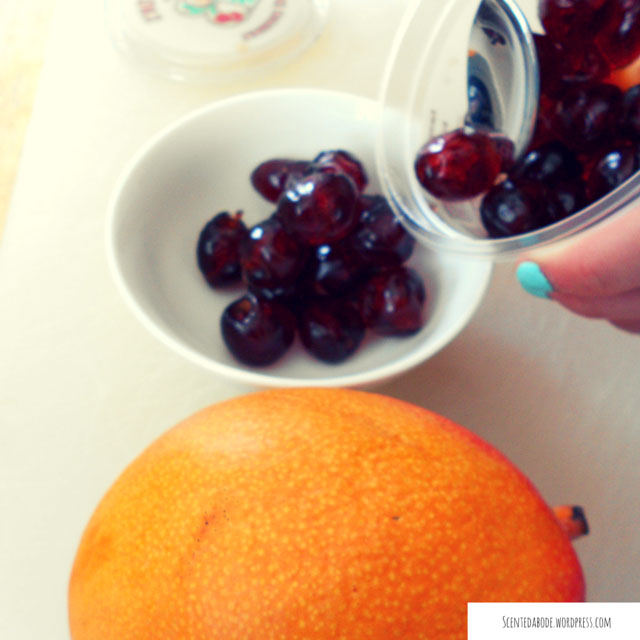
Having rummaged around in our cupboard, I discovered we were out of dried apricots, but we did have some dried figs, prunes and a tub of glacé morello cherries.

Mango and Morello Cherry

Over ripe Mango and morello cherries found in our cupboard

Since cherries would give the loaf some colour, I decided it would do rather than go and get some dried apricots. I like the idea of using what’s in a cupboard and experimenting more than sticking rigidly to a recipe. This is by far the best way of discovering something new and tasty.

By the time I had assembled the ingredients, my eldest appeared in the kitchen and decided to help with the baking. I was smiling since a few days ago I’d written a post about Google search trends, the British Bake off and that I would have to get my kids to help me with some baking.

There was no need to ask, baking is, next to Minecraft something that my eldest enjoys.

Based on the recipe from the River Cottage Family Cookbook, this loaf is very simple to make, there are no whisks or electrical appliances involved, just a spoon and some elbow grease.

Cream the sugar and butter together (Prior to this I had accidentally put flour into the bowl and had to separate the flour from the butter as I had been distracted by my daughter peeling the skin from the over ripe Mango and mashing it up with a fork).

Add the 2 eggs and beat until mixed together.

Add chopped morello cherries.

Add the grated zest of 1 lemon (we used half a lemon zest and all the zest of a small lime)

Add the mashed mango (or over ripe mashed bananas as in the original recipe instead) and add to the mix.

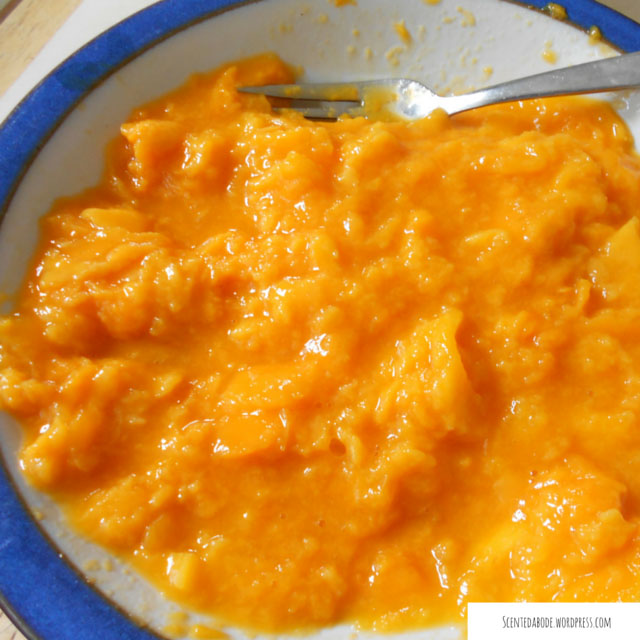
Mashed Mango for baking

Mashed overipe Mango

Gently fold in the self-raising flour.

Pour into a loaf tin which has been lined with a large loaf tin case, I like this as it’s easier to clean the loaf tin afterwards. It also means I don’t need to butter the tin.

Bake in a pre-heated oven for 50-60 minutes on 160c/Gas Mark 3 (Check around 50 minutes, put a knife/skewer through the middle and if it comes out clean, then it’s ready)

The lovely scent of the baking and the mango and cherry filled the kitchen and our living room and this got the attention of both my hubby and youngest who wanted to know when it would be ready to eat.

Unfortunately, they needed a bit of patience as once it was removed from the oven, it needed to cool on a baking rack before it can be enjoyed.

As the loaf was baked just before tea-time on Saturday, it was perfect to serve as our dessert. We usually find that although the loaf will keep for a few days, it never usually lasts longer than a day because it gets eaten as snack.

I think this recipe made with Mango and Cherry makes a lovely alternative to the bananas and apricot version.

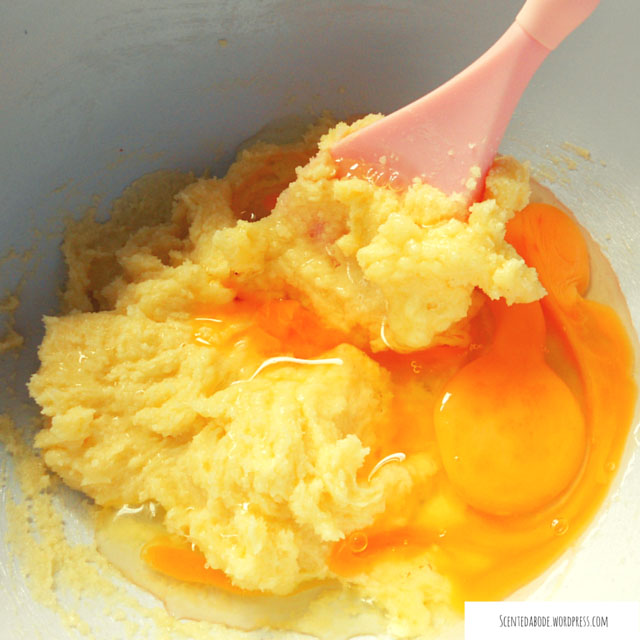
Softened butter with eggs and sugar

Soften Sugar and Butter and beat the eggs

For the reciepe:

Dried apricots (squidgy ones) or Morello Cherries 75g

Saltanas 75g (we didn’t have any so used more cherries)

1 Lemon

Unsalted butter, 100g soft but not melted

Caster Sugar 125g

2 large (free range) eggs

3 large ripe bananas (we used a large mango)

Self raising flour 200g

Loaf tin measuring about 13 x 23 x 7 cm

Do let me know if you’re looking forward to watching the Great British Bake-off.

Lavender picking afternoon in Carshalton

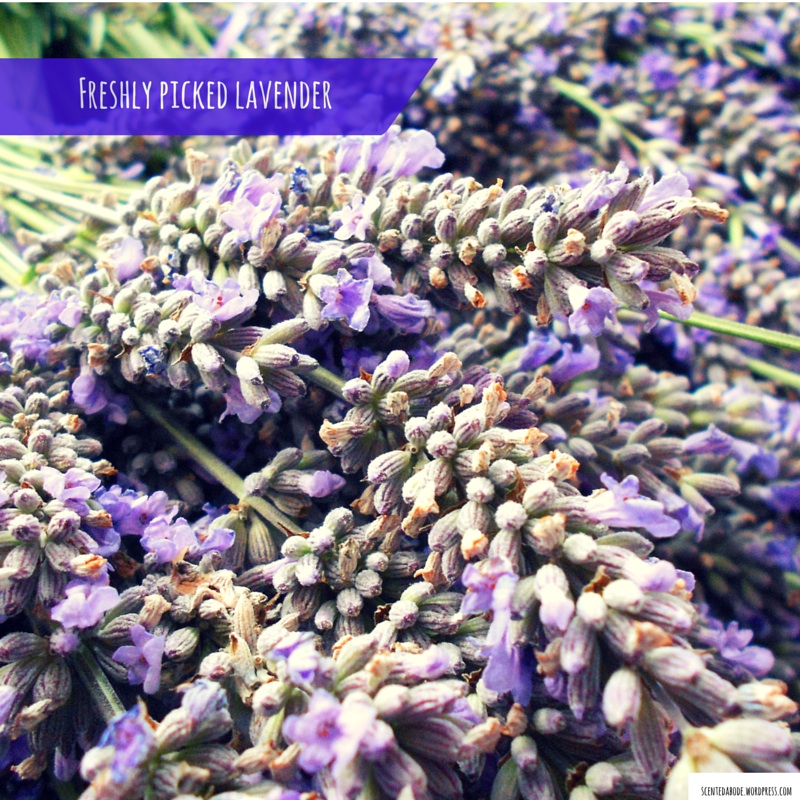
Freshly picked lavender from Carshalton

The weather forecast for last weekend was not good, both Siri and Google predicted a cloudy day with sunshine and rain. Not great for walking around in a field full of Lavender then.

However as Saturday morning arrived and I peeked out through the blinds, the sun was shining.

We decided to go because I’d always wanted to and this was the only weekend the event is held each year.

In the usual mum mode, I tried to persuade everyone to come along, but my eldest wasn’t going to be budged from her laptop. Only me then and my youngest. I made her wear a raincoat, plus a hat in case of both sun and rain. We must have been pretty funny to look at.

My husband drove us to Carshalton, it’s not really very far from our house, but it would have taken us a long walk.  With plenty of lavender we wanted to pick, I thought it best to save our energy for when we got there.

The field itself is tucked away in a quiet residential corner of Carshalton Village, less than 20 miles from Central London.

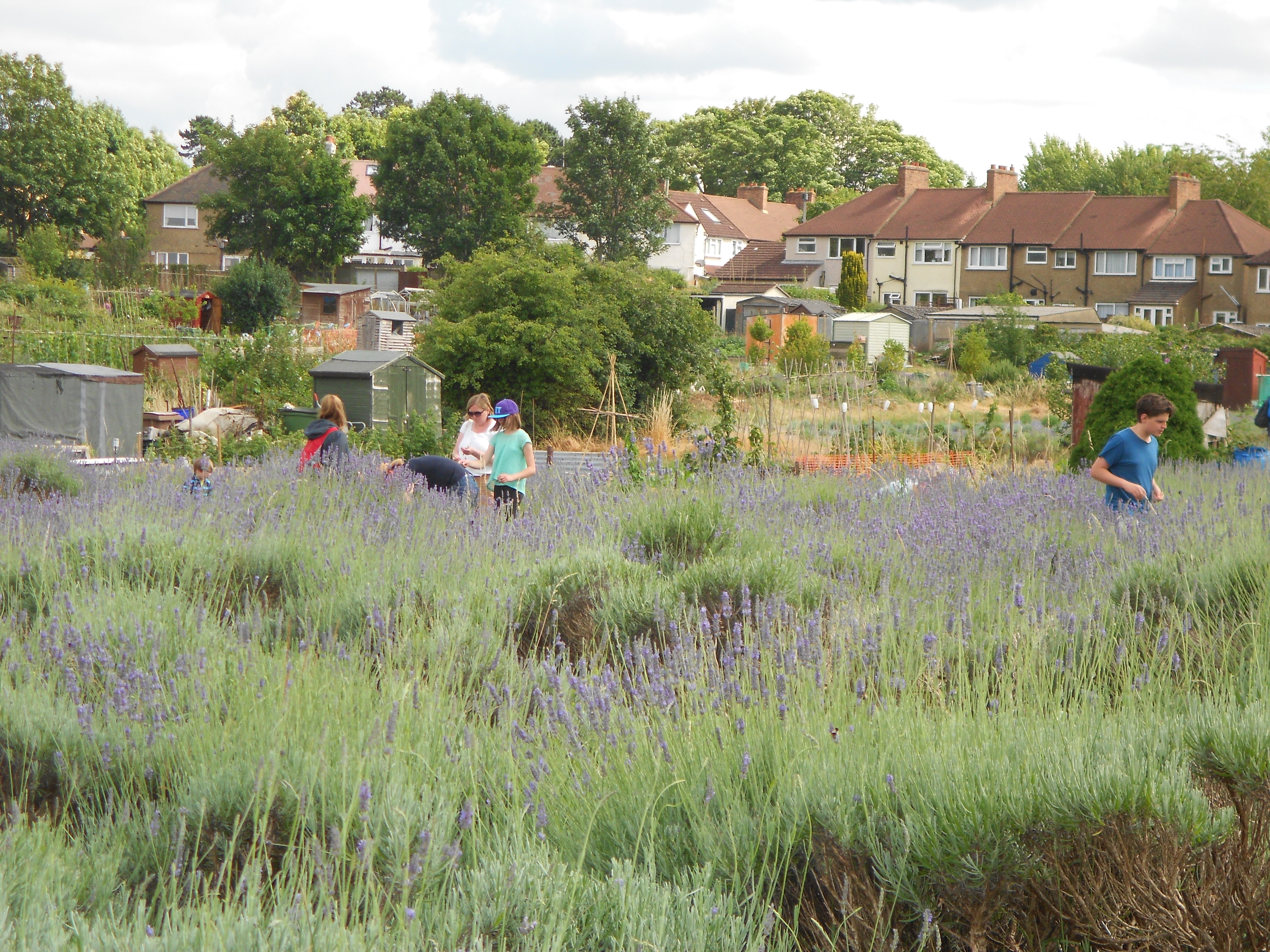
Field of lavender in Carshalton

Field of lavender in Carshalton

It is one of the few remaining sites where Lavender and other herbs was grown as part of a once a thriving industry for the Surrey towns and villages of Mitcham, Sutton and Carshalton.

I had read about the Lavender Picking in Carshalton at our local library some years ago and had always wanted to go, yet somehow, as each year passed, the opportunity also passed. It was either too wet or we had already planned something else.

It is run by local volunteers as a charity, keen to keep the lavender field and it’s history alive.

As we approached, there was no need for the directions or signs, a small steady stream of families, with buggies, young toddlers, teenagers, adults made their way to the field. Plenty were leaving too with huge bushels of Lavender in their arms or tucked into their shopping bags.

The sight of the people with their bags and armfuls of lavender got my youngest daughter so excited that she walked on ahead to investigate. If you’d like to see the post my daugther has written, please visit here it made made me laugh just reading it.

A small line of people were in front of us and we queued patiently to collect our bucket and scisssors.

Bucket of freshly picked lavender

Bucket of freshly picked lavender

Cutting the Lavender was the best, in the field were different varieties of lavender, some had shorter stems of blue grey colour with round soft flowering heads, whilst other lavender plants were tall and proudly waved their stems of deeper coloured lavender flowers in the summer breeze.

The fragrance was all around and we were enthralled as people mixed with butterflies and bees, collecting pollen and harvesting the lavender together.

No one seemed bothered by the bees as they buzzed around us collecting their harvest, as there seemed to be plenty for everyone.

The event would not be complete without a craft fair display. Locally produced goods was available, including ready to purchase cut bundles of Lavender alongside bottles of Lavender Essential oil which had been distilled from the lavender grown in the field.

If I could describe a perfect afternoon then this would be it. Our haul of lavender consisted of 2 large bales of lavender (I have no idea what I’m going to do with it all, but I expect none of it will go to waste), a little tiny bottle of the essential oil, apparently it takes about 3/4 of a ton of fresh lavender to produce about 11-12 pounds of oil. So very precious indeed.

Bees in lavender field

Bees in Lavender field

There was a demonstration with the distillery which had been made locally from recycled materials, so we got to learn about the process of distilling the lavender oil.

It’s made in a giant steel container. The process is a bit like one of those Morrocan Hookhas where the bottom of the container holds boiling water to steam the leaves or lavender in this case. As the steam rises, it passes through the freshly picked lavender and the oil from the steam is collected in a special reservoir and the water collected below. This water is the floral water that perfumers and the beauty industry call “hydrolat”.

As well as the oil, I purchased a small pot of Lavender to grow in our garden called Lavender Grosso.

After speaking with the gardener, I asked him which variety would be best for someone who isn’t very green fingered and wants to see the plant grow quick (I have no patience). Apparently Lavender Grosso grows to a meter high and is very fast growing and likes to be in sunshine, when planted in soil, it doesn’t need very much water (in a pot it will need watering frequently). It seemed the ideal plant suited to my temperament.

Lastly, my hubby spotted a small display of pots full of honey and jams, and we couldn’t resist purchasing a small pot of lavender honey.

And the rain stayed away until Sunday. perfect!